

Last Updated: October 29, 2026
Quick Summary
To write a suspense novel with intricate subplots, first define one central question the reader cannot stop asking. Then make every subplot either feed that question or complicate it, cutting any storyline that does neither.
- Write the central question of your suspense novel in one sentence and keep it visible.
- Give every major character a goal, a hidden motive, and a conflicting desire.
- Make each subplot cross the main plot at least twice and pay off before or at the climax.
- Plant every fair-play clue on the page and track it in a clue ledger.
- Keep a reveal every three to five chapters, with the biggest reveals at the midpoint and climax.
Table of Contents
- Start With the Main Suspense Plot and Its Central Question
- Building Character Goals, Motives and Conflicting Desires
- How to Create Suspense in a Novel Across Multiple Storylines
- How to Write Subplots That Feed the Main Mystery
- Subplot Examples in Fiction and What They Teach
- Novel Plotting Outline Template for Suspense With Subplots
- Revising Your Draft and Booking Your Next Read on Suspense Craft
- Frequently Asked Questions
Start With the Main Suspense Plot and Its Central Question
A suspense novel lives or dies on one question the reader cannot stop asking. Before you write a single subplot, decide what that central question is. Is the detective hunting a killer?
Every subplot should either feed that question or complicate it. If a storyline does neither, cut it. Many first drafts fail because the writer has three good stories and no shared engine driving them.
Here is a simple test. Ask whether the reader would still want to know the answer if every other storyline disappeared.
Building Character Goals, Motives and Conflicting Desires
Suspense depends on characters who want something badly and cannot easily get it. Give every major character a concrete goal, a hidden motive, and a conflicting desire that pulls against someone else’s plan.
Make goals collide. A sister wants the truth about a death. The police chief wants the case closed before an election. Their opposing needs create scenes that crackle without any extra explosions.
Write a short profile for each key character:
- Goal: What they are actively trying to do
- Motive: Why it matters to them personally
- Hidden desire: What they would never admit out loud
- Opposition: Who or what gets in their way
Use this profile to check every scene. If a character enters a room with no goal, the scene will feel slow.
How to Create Suspense in a Novel Across Multiple Storylines
Suspense comes from uncertainty plus stakes. The reader must care about an outcome and not know how it will turn out. Spread that tension across storylines so no single thread has to carry the whole weight alone.
Try these techniques:
- Foreshadow early. Plant a small detail that pays off later, such as a locked drawer or a cracked phone screen.
- Put characters in jeopardy. Threaten something the reader has grown to love.
- End scenes on a question. Stop just before the reveal, not after it.
- Rotate the cliffhangers. Close one subplot’s chapter while another opens. Keep the reader moving between threads.
A common mistake is leaving every storyline on a cliffhanger at once. Readers get exhausted. Alternate the peaks so the tension rises and falls.
How to Write Subplots That Feed the Main Mystery
Subplots are where intricate novels earn their complexity. The best ones give the reader new information, new suspects, or new pressure on the protagonist. They should never feel like detours.
Start by asking what each subplot reveals about the central question. A subplot about a failing business might explain why a suspect had money. A romance might put the protagonist in the room when a key document disappears.
Keep a short list of what each subplot contributes:
- A clue the main plot needs
- A suspect who looks innocent and is not
- A cost the protagonist must pay to keep going
Mapping Subplots Alongside the Main Plot
Draw a simple grid on paper or in a spreadsheet. List the main suspense plot across the top and each subplot down the side. Mark every chapter where each thread moves forward.
This map shows you at a glance whether one thread goes silent for ten chapters or two threads peak in the same scene. Fix the gaps before you draft.
Keeping Pacing Intact When Storylines Interweave
Interweaving is where pacing usually breaks. Aim to advance each active thread at least every few chapters. When a subplot goes quiet, the reader forgets why it mattered.
Give each thread its own rhythm. The main plot might move in short, sharp chapters. A slower subplot can breathe a little longer, provided it ends on a new piece of information.
Subplot Examples in Fiction and What They Teach
Most guides tell you to study published suspense novels and leave it there. That advice is useless without a worked example, so here is a full plot architecture you can copy, followed by a method for extracting the same lessons from any book you admire.
A Worked Example: One Main Plot, Three Subplots, Timed Reveals
Take a hypothetical domestic suspense novel. The central question: Did the husband kill his business partner, or is someone framing him?
Main plot beats:
- Chapter 1: The partner is found dead; the husband’s alibi has a two-hour hole.
- Chapter 8: A second suspect emerges, the partner’s widow, who stood to inherit.
- Chapter 15 (midpoint): The protagonist discovers her husband lied about the hole, but not why.
- Chapter 24: The widow’s alibi collapses.
- Chapter 30 (climax): The protagonist must choose whether to hand over evidence that clears her husband but convicts her brother.
Subplot A, the failing family business. Goal: keep the company afloat.
Subplot B, the protagonist’s estranged brother. Goal: reconcile before their mother’s surgery.
Subplot C, a neighbour’s missing dog. Goal: find the dog.
Notice the pattern: every subplot is introduced early, crosses the main plot at least twice, and pays off before or at the climax. None is a detour.
How to Extract Lessons From Any Novel You Admire
Pick a suspense novel you know well and build a three-column table: subplot, where it crosses the main plot, where it pays off. Fill it in chapter by chapter. Then ask three questions:
- How was each subplot introduced? Usually in a scene that also advances the main plot, so the reader never feels the story stop.
- Where does each thread cross the main plot? Count the crossings. Fewer than two is a warning sign.
- How does each subplot pay off? Does it deliver a clue, a cost, or a choice, or does it simply fade?
A subplot that never touches the central question usually does not belong in the book. A subplot that touches it once and vanishes is a dangling thread.
Run this exercise on a novel in your own genre before you outline. You will spot the architecture faster than any craft book explains it.
Fair-Play Clues Across Multiple Threads
Suspense readers expect to be able to solve the mystery in principle. That means every clue must be planted on the page, even if buried in a subplot.
Keep a clue ledger as you draft: one line per clue, the chapter it is planted, the chapter it pays off, and which thread carries it. If a payoff has no matching plant, you have cheated the reader.
Novel Plotting Outline Template for Suspense With Subplots
A template is only useful if it forces coordination. The version below adds a reveal schedule and a thread audit, so you can see at a glance whether your subplots are carrying their weight or quietly sinking the pacing.
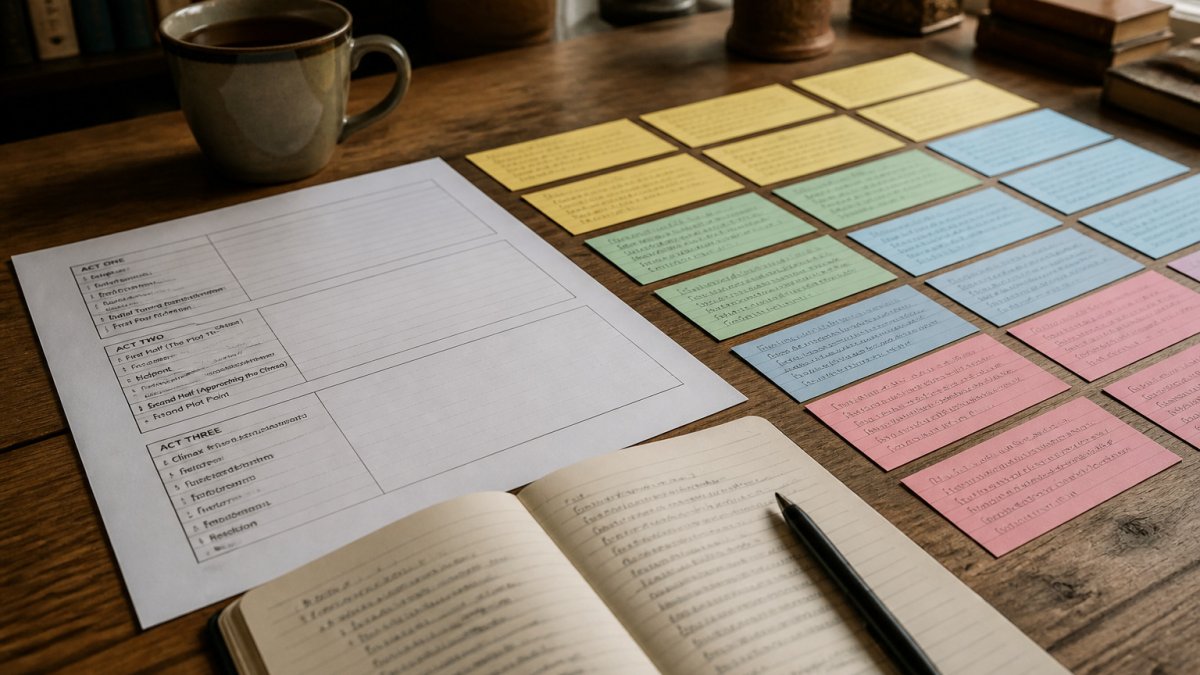
The Core Template
MAIN SUSPENSE PLOT
Central question: ____________________
Opening hook: ____________________
Midpoint reversal: ____________________
Climax: ____________________
Resolution: ____________________
SUBPLOT 1
Goal: ____________________
Connects to main plot at chapter: ____
Second crossing at chapter: ____
Payoff chapter: ____
Information it reveals: ____________________
SUBPLOT 2
Goal: ____________________
Connects to main plot at chapter: ____
Second crossing at chapter: ____
Payoff chapter: ____
Information it reveals: ____________________
CHARACTER CHECK
Protagonist goal: ____________________
Opponent goal: ____________________
Hidden motive: ____________________
Fill in every blank. If a subplot has no payoff chapter, it needs one or it should go. If it has only one crossing, add a second or cut the thread.
The Reveal Schedule
List every major reveal in the book and the chapter it lands. Then check the spacing. A common pattern is a reveal every three to five chapters, with the biggest ones at the midpoint and the climax. If two reveals land in the same chapter, consider moving one, stacked reveals flatten the tension curve. If six chapters pass with no reveal, the middle will sag.
| Reveal | Chapter | Thread that carries it |
|---|---|---|
| Secret loan | 4 | Subplot A |
| False alibi | 12 | Subplot B |
| Timeline clue | 22 | Subplot C |
| Midpoint lie | 15 | Main plot |
The Thread Audit
Before you revise, run this audit on your draft:
- Scene-purpose test. For every scene, write one sentence: This scene advances [thread] by [change]. If you cannot fill both blanks, the scene is filler.
- Silence check. Mark every chapter where each thread appears. Any thread silent for more than four chapters needs a beat or a cut.
- Crossing count. Each subplot should cross the main plot at least twice. One crossing is a cameo, not a subplot.
- Payoff check. Every planted clue needs a payoff chapter. Every payoff needs a plant.
- Climax contribution. At least one subplot should force a choice or cost in the climax. If none does, the subplots are decoration.
Cut-and-Combine Exercise
If the audit shows subplot overload, too many threads, too few crossings, try combining two weak subplots into one stronger thread. A failing business and a gambling debt can become a single financial-pressure subplot. A romance and a family estrangement can become one relationship thread. Fewer, deeper threads almost always beat many shallow ones.
Do not confuse a subplot with a scene goal. A character wanting something in a single scene is not a subplot. A subplot is a thread that runs across chapters and changes the main story.
A subplot earns its place when it crosses the main plot at least twice, pays off before or at the climax, and forces a cost or choice. If it does none of those, cut it.
Revising Your Draft and Booking Your Next Read on Suspense Craft
Revision is where intricate plots either sharpen or sag. Read your draft and check each subplot against the central question. Ask whether it still earns its place. Look for threads that vanished for too long and for scenes where nothing changed.
Work through this checklist:
- Every subplot connects to the central question
- Each thread advances at least every few chapters
- Every foreshadowed clue pays off
- The protagonist pays a real cost at least once per act
- Each chapter ends on a question
If you want to see these techniques in action, read a few suspense novels with complex plots and study how they manage their threads.
Frequently Asked Questions
What is suspense in storytelling?
Suspense is the reader’s sense of uncertainty about what will happen next, usually tied to a character who has something important to lose. It is built by withholding information, raising stakes and making the outcome feel genuinely open. In a suspense novel, each chapter should leave the reader asking a question the next scene must answer. Suspense differs from surprise: the reader knows the danger is coming and wants to see how the character handles it.
How do you weave multiple subplots into one story?
Start by listing each subplot and the character whose goal drives it, then check that every subplot touches the main suspense plot at least at a few key points. Stagger the subplots so the reader is not switching threads on every page, and make sure a development in one storyline changes the stakes in another. A simple thread map showing which subplot appears in which chapter will show you gaps and overloaded sections before you draft.
How many subplots should a novel have?
Most suspense novels work well with one main plot and two or three subplots, each with its own character goal and payoff. More than that usually makes the book hard to track unless the storylines are tightly linked. Count the number of threads you can hold in your head during a revision pass; if you lose track, the reader probably will too. Cut or merge any subplot that does not change the main plot or a character’s arc.
How do you resolve subplots without weakening the main ending?
Resolve each subplot in the chapters just before or shortly after the climax of the main plot, so the reader sees every thread close without a long tail. Let a subplot’s resolution be a consequence of the main plot’s climax where possible, which ties the threads together rather than setting them aside. Check your plotting outline for any subplot that has no payoff and either give it one or remove it.
