

Last Updated: October 22, 2026
Quick Summary
To start reading a mystery series in order, find the first published novel using the author’s bibliography, the publisher’s series page, or your library catalogue, then read in publication order. Check whether the series resets each book or builds across volumes, and start with book one.
- A prequel published later but set earlier in the timeline is the classic reading-order trap.
- If two sources disagree on order, trust the most recent edition with corrected series numbering.
- Read in publication order first, then try chronological order on a second pass.
- Cozy mysteries usually have flexible entry points, so you can start mid-series.
- Read two books before deciding to quit a series that starts weakly.
Table of Contents
- Why Reading a Mystery Series in Order Matters
- Mystery Series Reading Order: How to Find the Right Sequence
- Chronological Order vs Publication Order: Which Should You Follow?
- The Best Mystery Series for Beginners to Start With
- Standalone Mystery Novels: When One Book Is Enough
- A Step-by-Step Process for Choosing Your First Mystery Series
- Spoilers, Continuity and Flexible Entry Points
- Conclusion
- Frequently Asked Questions
Why Reading a Mystery Series in Order Matters
Starting a mystery series out of sequence is the fastest way to spoil a good story.
Skip ahead and you learn who the killer was in book four before you’ve read book one. You also meet a detective who already knows the supporting cast, while you don’t. That gap kills the pleasure of discovery.
Readers often give up on a great series simply because they picked up book three first, assumed the writing was the problem, and never went back.
Many mystery series also track a character arc across instalments: a marriage breaks down, a partner leaves, a cold case resurfaces.
You don’t always need strict order.
Mystery Series Reading Order: How to Find the Right Sequence
Finding the correct order for a mystery series takes about ten minutes. Three sources settle it: the author’s bibliography, the publisher’s series page, and your library catalogue.
Start with the author, because they know their own books best.
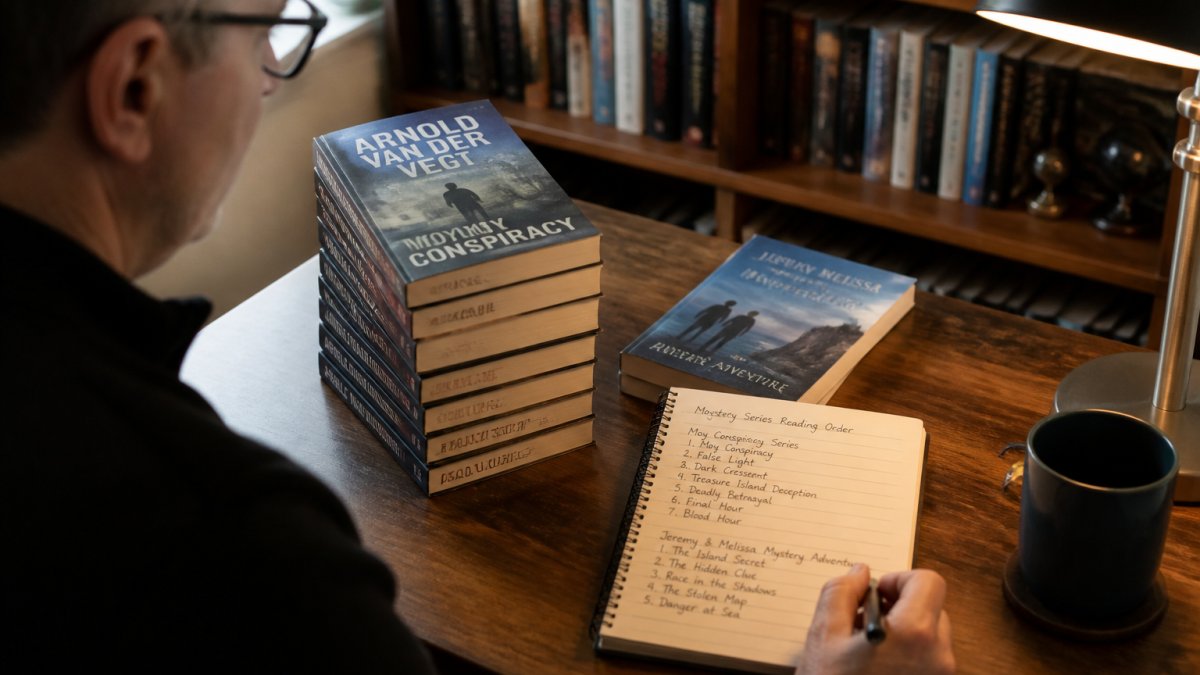
Checking the Author’s Website and Bibliography
An author’s website is the most reliable source for reading order. Look for a page labelled “Books”, “Series” or “Bibliography”; most authors list titles in publication order and mark which series each book belongs to.
Two things to check while you’re there:
- Whether the author writes more than one series, and which titles belong to which
- Whether any book is a prequel written later but set earlier in the timeline
A prequel is the classic trap: published last, but first in the story’s chronology. Authors usually flag this, but not always.
If the website is out of date, check the publisher’s catalogue page; publishers keep series listings current because they sell boxed sets.
How to Verify a Series Bibliography
A short verification routine catches most bibliography errors before you buy.
- Find the first published novel, not the first chronological story. Check the copyright page or the publisher’s listing for the original release year.
- Separate novels from novellas and short stories. Many series include short stories that sit between novels. They are usually optional; the novels carry the main arc.
- Check for later prequels. A prequel published after book five is still a prequel. Reading it first can spoil reveals the author designed for later.
- Check for spin-offs. A spin-off series featuring a side character has its own order and should not be mixed into the main run.
- Cross-check two sources. If the author’s site and the publisher’s catalogue disagree, trust the more recent edition, which usually carries corrected series numbering.
Retailers often slot a later novella between two novels. That’s fine for completists, but a new reader can skip the short fiction without losing the plot.
Using Library Catalogues and Bookstore Listings
Library catalogues and online bookstore listings display series information and are often more current than an author’s site.
In a library catalogue, search the author’s name and check the series field in each record; many catalogues sort by publication date, giving you the order in seconds.
In bookstore listings, search the series name rather than the author, then sort by publication date. Retailers group series together because readers buy them in sequence.
If two sources disagree on order, trust the most recent edition. Authors and publishers reissue books with corrected series numbering, and older listings often keep the original, wrong sequence.
Flexible Entry Points Versus Strict Sequencing
Once you have the order, decide how much it matters.
A strict sequencing series builds across volumes: the detective’s past, relationships and old cases carry forward, and later books assume you know what happened.
A quick test: read the blurb for book three.
This classification is the step most guides skip, and it decides whether you can safely sample a later book or need to begin at the beginning.
Chronological Order vs Publication Order: Which Should You Follow?
Publication order is the safest choice for almost every mystery series.
Chronological order follows the story’s timeline instead. It can be more satisfying for a re-read, but it’s risky the first time through.
Here’s the difference in practice:
| Order type | What it follows | Best for | Risk |
|---|---|---|---|
| Publication order | The order books were released | First-time readers | None, it’s the default |
| Chronological order | The story’s internal timeline | Re-reads and completists | Spoils later reveals |
| Recommended order | The author’s own suggested sequence | Series with prequels | Requires checking the source |
Prequels cause most of the confusion.
Our rule: read in publication order first, then try chronological order on a second pass. You only get one first read.
The Best Mystery Series for Beginners to Start With
That last point matters more than most guides admit. A good series opener resolves its own mystery. It leaves you curious about the detective, not confused about the plot.
Below is a starter list with the series name, the first book, and a note on how strictly the order matters.
| Series | First book | Order notes |
|---|---|---|
| The No. 1 Ladies’ Detective Agency (Alexander McCall Smith) | The No. 1 Ladies’ Detective Agency | Gentle, episodic; flexible entry points after book one |
| Inspector Rebus (Ian Rankin) | Knots and Crosses | Strict sequencing; Rebus’s past builds across the run |
| Phryne Fisher (Kerry Greenwood) | Cocaine Blues | Largely episodic; later books reference earlier characters |
| Cormoran Strike (Robert Galbraith) | The Cuckoo’s Calling | Strict sequencing; the detective’s backstory is the spine |
| Flavia de Luce (Alan Bradley) | The Sweetness at the Bottom of the Pie | Light continuity; each book resolves its own case |
| Inspector Montalbano (Andrea Camilleri) | The Shape of Water | Mostly episodic; recurring cast rewards order |
| Vera Stanhope (Ann Cleeves) | The Crow Trap | Strict sequencing; Vera’s team changes across books |
| Maisie Dobbs (Jacqueline Winspear) | Maisie Dobbs | Strict sequencing; the series tracks a long character arc |
Publication dates vary by market, so confirm the first book against the author’s bibliography before you buy.
Cozy Mystery Series for Gentle Entry Points
Cozy mysteries are the easiest entry into the genre: violence happens off the page, the amateur sleuth is relatable, and the setting does a lot of the work.
Look for a cozy series where the first book introduces:
- An amateur sleuth with a reason to investigate
- A small community with a believable cast of suspects
- A hobby, job or town that anchors each later book
Cozy series tend to have flexible entry points, so many readers start mid-series and go back later. The Phryne Fisher books are a good example: the setting and supporting cast carry over, but each case stands alone.
Detective Fiction Series with Strong Recurring Characters
Detective fiction runs the other way. These series reward strict order, because the detective changes across the books.
A recurring detective carries baggage: old cases, damaged relationships, a reputation in the force. Each instalment adds to that weight.
If you want a detective series to commit to, start with book one and stay in publication order. The payoff comes in the later books, when earlier events return.
Readers who want a series to follow for years rather than a single holiday read.
A Note on Our Own Series
For readers who want a series with a strong sense of place, Arnold Van Der Vegt’s Jeremy and Melissa Mystery Adventure series is written for young teens and young adults. It follows two young sleuths through travel-driven mysteries, and the books build on each other, so start with the first instalment. It sits alongside the adult crime fiction title Moy Conspiracy, which is a standalone and can be read without any prior series knowledge.
Standalone Mystery Novels: When One Book Is Enough
Standalone mystery novels tell a complete story in one volume: no sequel, no recurring detective, no order to work out.
Standalones suit a few kinds of reader:
- Anyone with limited reading time who wants a full story in one go
- Readers who like variety and don’t want to commit to a long series
- Book club members who need a title everyone can finish
Standalones also make good palate cleansers between long series: read three books about the same detective and you start predicting the author’s moves.
The trade-off is real: you lose the slow build of a recurring character, the main pleasure of a series.
A Step-by-Step Process for Choosing Your First Mystery Series
Choosing your first mystery series comes down to matching the series to how you actually read.
- Decide your commitment level. One book a month for a year is a different ask from a weekend read. Be honest about it.
- Pick your subgenre. Cozy, detective fiction, thriller or amateur sleuth. Each has a different pace and tone.
- Check the series length. A trilogy is easier to commit to than a twenty-book run.
- Read the first book’s sample. Most bookstores and libraries offer a preview chapter. Use it.
- Confirm the order. Check the author’s site or your library catalogue before you buy.
- Note the entry points. Find out whether the series resets each book or builds across instalments.
- Start with book one. Even if later books are better, book one sets the rules of the world.
That’s a ten-minute process that saves hours of false starts. It works for any series, in any subgenre, at any length.
Don’t judge a series by its weakest first book. Plenty of series improve sharply once the author settles into the character. Read two books before you decide to quit.
Spoilers, Continuity and Flexible Entry Points
Some mystery series reset with every book. Others build a single story across many volumes.
A flexible entry point is a book you can start with mid-series without missing much.
Strict sequencing is the opposite. The books build on each other, and later instalments assume you know what happened before.
Our rule of thumb:
- If the blurb mentions the detective’s past, read in order
- If the blurb mentions only the crime, you can probably jump in
- If you’re unsure, start with book one and lose nothing
Spoilers also travel. Fan wikis and review sites often reveal endings without warning.
Conclusion
Starting a mystery series the right way takes one evening of checking and saves you a spoiled reveal. Confirm the order, read book one first, and give the series two books before you judge it.
If you want a series built on travel, remote settings and characters who hide more than they show, our books are a good place to begin. Our catalogue includes adult crime fiction such as Moy Conspiracy, plus the Jeremy and Melissa Mystery Adventure series for younger readers.
Browse the collection and start with the first book in whichever series suits you.
Frequently Asked Questions
Do you need to read a mystery series in order?
It depends on the series. Many detective fiction series work fine out of order because each book resolves its own case, but ongoing character arcs and relationships build across installments. If a series has a strict sequence, starting mid-way can spoil earlier reveals. Check whether the author labels books as numbered installments or writes them as flexible entry points. When in doubt, begin with book one to preserve the full experience of the mystery series.
How do you find the first book in a mystery series?
Start with the author’s official website or the bibliography page inside a later installment, which usually lists titles in publication order. Library catalogues and bookstore listings also show series numbers. Look for labels like ‘Book 1’ or ‘A Novel’ versus numbered entries. If the series has a prequel written later, decide whether you want chronological order vs publication order before you begin reading.
What is a good mystery series for a beginner?
Beginners often do well with cozy mystery series and classic detective fiction where each book stands alone. These give you a complete investigation per installment while still building a recurring character over time. Look for the best mystery series for beginners by checking whether the first book introduces the protagonist cleanly and whether later books depend heavily on earlier plots. Reading a sample chapter helps confirm the pacing suits you.
Can you read standalone mystery novels instead of a series?
Yes. Standalone mystery novels deliver a complete story in one book, with no commitment to a long reading order. They suit readers who want variety, commute reading, or book club picks that everyone can finish quickly. Many authors write both standalone thrillers and series installments. If you enjoy a standalone, check whether the author has a mystery series with a recurring detective you can explore next.