

Table of Contents
- Jane Harper vs Michael Robotham: A Quick Comparison
- Jane Harper: Atmospheric Outback Noir
- Michael Robotham: Psychological Suspense and Series Detectives
- Writing Styles Compared: Atmosphere vs. Psychology
- Psychological Thriller Novels for Book Clubs
- Must-Read Australian Mystery Books
- Arnold Van Der Vegt Mystery Novels: A Fresh Voice
- Conclusion
- Frequently Asked Questions
Last Updated: September 14, 2026
Jane Harper vs Michael Robotham: A Quick Comparison
Jane Harper vs Michael Robotham is the comparison Australian crime fiction readers keep returning to, because the two authors sit at opposite ends of the same genre. Harper built her reputation on atmospheric outback noir, where the landscape itself becomes a suspect. Robotham made his name with psychological suspense and recurring series detectives. This guide from Arnold Van Der Vegt breaks down their styles, key works, and which one suits your reading habits.
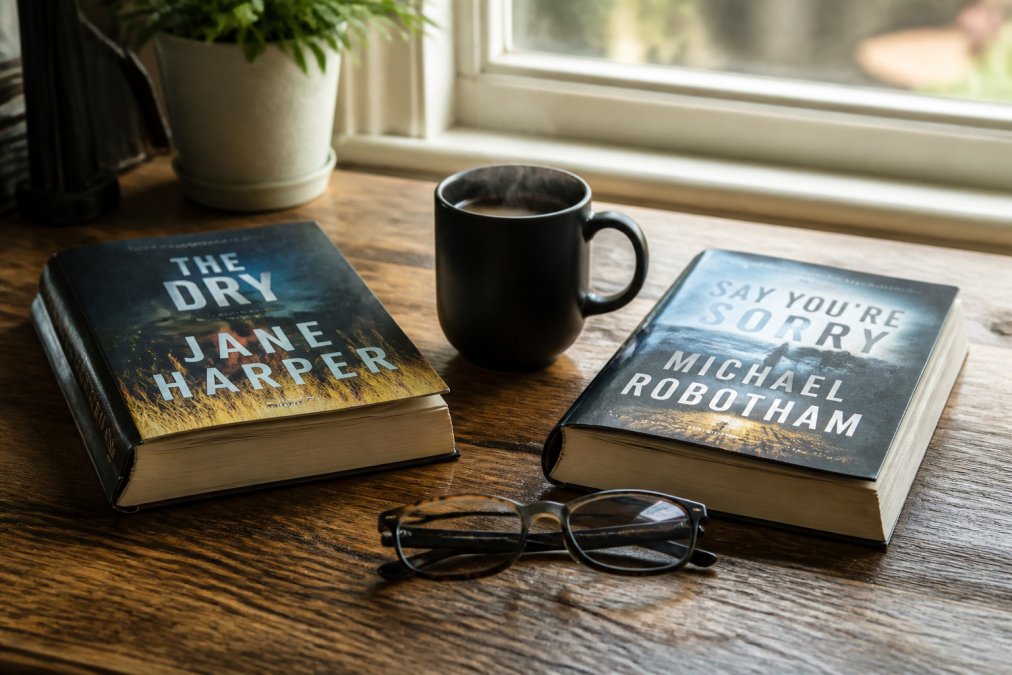
| Author | Signature Style | Best-Known Series | Best For |
|---|---|---|---|
| Jane Harper | Atmospheric, slow-burn outback noir | Aaron Falk | Readers who want setting as character |
| Michael Robotham | Psychological suspense, tight pacing | Joseph O’Loughlin, Cyrus Haven | Readers who want twists and interior drama |
The short version: pick Harper when you want heat, dust, and a town full of secrets. Pick Robotham when you want a narrator you cannot quite trust.
Jane Harper: Atmospheric Outback Noir
Harper’s novels take a single, isolated community and slowly apply pressure until something cracks. Her debut, The Dry, introduced federal police investigator Aaron Falk returning to the drought-stricken town he left as a teenager. The book won the Victorian Premier’s Literary Award for an Unpublished Manuscript and went on to become an international bestseller, with the film adaptation following in 2021 (The Wheeler Centre).
Key Works and Awards
Beyond The Dry, Harper’s back catalogue includes Force of Nature, The Lost Man, and Exiles. The Lost Man stands apart because it drops the series detective entirely and lets the remote setting carry the narrative tension. Her work has drawn comparisons to the literary elite of crime writing, and she has been shortlisted for the Gold Dagger, one of the genre’s most recognised international awards.
What makes Harper’s books work is restraint. The plot twist usually arrives quietly, and the real payoff is the character development of a town under strain.
Michael Robotham: Psychological Suspense and Series Detectives
Robotham came to fiction from a journalistic background, and it shows in his pacing. He spent years as a ghostwriter and reporter before publishing The Suspect in 2004, which introduced clinical psychologist Joseph O’Loughlin. That series ran for nine books and established Robotham as a master of the unreliable, self-doubting narrator.
Key Works and Awards
His second major series features Cyrus Haven, a forensic psychologist, and Evie Cormac, a young woman with a mysterious past. Good Girl, Bad Girl launched that run, and When She Was Good followed. Robotham has won the Gold Dagger twice, an achievement that places him among the most decorated crime writers working today.
Where Harper is patient, Robotham is propulsive. His chapters are short, his cliffhangers frequent, and his suspense built from what characters refuse to say to each other.
Writing Styles Compared: Atmosphere vs. Psychology
The clearest way to separate these two is to ask what each author treats as the source of danger, and then to look at how that choice shows up in the mechanics of the prose.
Point of view. Harper works almost exclusively in close third person, and she tends to lock the reader to a single investigator’s field of vision. In The Dry, you only know what Aaron Falk knows, and the town’s hostility is filtered through his memory of having grown up there. Robotham frequently shifts between first and third person, and his Joseph O’Loughlin books use a first-person narrator whose professional training as a clinical psychologist gives him the vocabulary to rationalise his own bad decisions. That gap, between what a narrator can explain and what he will admit, is the engine of Robotham’s suspense.
Pacing and structure. Harper’s chapters are long and cumulative. She front-loads atmosphere and lets the plot accelerate in the final third, which is why readers often describe her books as slow-burn. Robotham inverts this: short chapters, frequent scene breaks, and a cliffhanger at the end of most of them. The practical effect is that Harper rewards sustained reading sessions, while Robotham is built for the twenty-minutes-before-sleep reader who wants a reason to turn one more page.
Dialogue. Harper’s dialogue is sparse and often evasive, characters answer questions with questions, and the silences carry as much information as the exchanges. Robotham’s dialogue is denser and more confrontational, and he uses it to plant misdirection. A Robotham conversation frequently ends with the reader realising that the most important line was the one that seemed incidental.
Setting as mechanism. In Harper’s work the landscape is not decoration; it actively constrains the plot. Distance, heat, and unreliable roads determine who can reach whom and when. Robotham’s settings are more portable, a hospital, a suburban house, a police interview room, and the constraint comes from the characters’ professional and personal obligations rather than geography.
Series versus standalone. Harper has written both, and The Lost Man demonstrates what she does when she removes the series detective: the setting has to carry more weight, and the resolution becomes more about the community than about any individual investigator. Robotham’s two main series, O’Loughlin and Cyrus Haven, both depend on a long-running relationship between two characters, and the accumulated history between them is part of the tension in every book.
If you read for mood and place, Harper delivers. If you read for momentum and psychological games, Robotham delivers. Neither is the “better” writer, they solve different structural problems on the page, and knowing which problem you enjoy is the fastest way to pick your next book.
Psychological Thriller Novels for Book Clubs
Book clubs tend to favour psychological thriller novels because they generate disagreement, and disagreement is what makes a meeting worth attending. Robotham’s Cyrus Haven books are strong picks here: the central relationship between Haven and Evie gives members plenty to argue about, and the moral ambiguity resists easy conclusions.
Harper’s The Lost Man also works well for group discussion, particularly around how isolation shapes behaviour. The book raises questions about family loyalty and rural masculinity that most readers have an opinion on before they finish chapter three.
How to Choose a Book Club Pick
- Check whether the group prefers plot-driven or character-driven discussion
- Rotate between atmospheric and psychological titles across the year
- Pick one book with an unresolved ending to spark debate
- Assign a member to research the author’s background before the meeting
A common mistake with book club picks is choosing the longest book on the shelf. Shorter, sharper psychological thrillers often produce better discussion than sprawling ones, because every member actually finishes them.
Must-Read Australian Mystery Books
Any list of must-read Australian mystery books has to start with the writers who reshaped the genre internationally, but the more useful question for a reader is not “which are best”, it is “which one should I pick up first, given what I already like.”
If you like slow-burn literary fiction with a crime frame: start with The Lost Man. It is a standalone, it removes the series detective entirely, and it is the clearest demonstration of Harper’s method, a family, a remote property, and a death that the landscape itself seems to have caused. It is also the book most likely to appeal to readers who normally avoid genre fiction.
If you like a procedural with a returning investigator: start with The Dry. It introduces Aaron Falk, it establishes the outback-noir template, and it is short enough to finish in a weekend. Follow it with Force of Nature and Exiles if the character works for you.
If you like psychological suspense with an unreliable narrator: start with The Suspect. It is the first Joseph O’Loughlin book, and it sets up the pattern Robotham returns to throughout the series, a professional whose expertise becomes a liability.
If you like a two-hander with a long-running relationship: start with Good Girl, Bad Girl. The Cyrus Haven and Evie Cormac dynamic is the most emotionally charged pairing in Robotham’s catalogue, and When She Was Good continues it directly.
If you want to read outside the two headline names: the broader field includes writers working in police procedural, rural noir, and contemporary fiction, and the genre conventions are consistent, remote settings, closed communities, and an investigator who is personally implicated in the case. What changes is the narrative voice and the pacing, and that is where reader preference decides everything.
A practical way to build a shelf is to alternate: one atmospheric title, then one psychological title, then a standalone, then a series entry. That rotation keeps the genre from feeling repetitive and makes it easier to identify which mode you actually prefer.
Australian crime writing and genre awards overview
Arnold Van Der Vegt Mystery Novels: A Fresh Voice
Readers who have worked through the established names often ask what comes next, and that is where Arnold Van Der Vegt mystery novels enter the conversation. Van Der Vegt writes mystery and suspense fiction shaped by real-world travel and observation, with a background in the armed services and extensive international travel informing the settings.
His adult crime fiction includes Moy Conspiracy, a tense story built around cunning characters and high-stakes challenges. For younger readers, the Jeremy and Melissa Mystery Adventure series offers age-appropriate mystery adventure written for young teens and young adults, with exotic settings and fast-moving plots. The two are distinct: Moy Conspiracy is written for adult readers, while the Jeremy and Melissa series is designed for a younger audience.
Where Harper and Robotham tend to stay close to home soil, Van Der Vegt’s books lean into remote and adventurous settings drawn from lived experience. Readers who want a mystery that moves across the map, rather than settling into one town, will find the back catalogue worth exploring.
Australian crime writing and genre awards overview
Conclusion
Choosing between these authors comes down to what you want from a crime novel: the slow pressure of place or the quick turn of a psychological screw. Both deliver, and most readers end up keeping all three names on the shelf.
If you have exhausted the well-known titles and want something with a different geographic pulse, Arnold Van Der Vegt offers immersive storytelling, remote and adventurous settings, and plots built to hold your curiosity to the final page. Start with Moy Conspiracy for adult crime fiction, or the Jeremy and Melissa Mystery Adventure series for a younger reader. Shop now and find your next read.
Frequently Asked Questions
Who else writes like Michael Robotham?
If you appreciate Michael Robotham’s psychological depth and series detectives, try authors like Nicci French, Sophie Hannah, or Minette Walters. These writers also focus on the inner lives of characters under pressure. For a fresh take, Arnold Van Der Vegt mystery novels offer tense plots with cunning characters and remote settings, making them a strong fit for readers who enjoy psychological suspense.
How do the writing styles of Jane Harper and Michael Robotham differ?
Jane Harper’s style is atmospheric and place-driven, with the landscape acting as a character. Her pacing is slow-burn, building tension through environment. Michael Robotham leans more psychological, with faster pacing and a focus on the detective’s personal struggles. Harper’s books often feel like modern classics of outback noir, while Robotham’s are more in the thriller genre, driven by plot twists and character-driven suspense.
Are there other authors who capture the same suspense as Arnold Van Der Vegt?
Readers who enjoy Arnold Van Der Vegt mystery novels often look for authors who blend fast-paced mystery with remote settings. While Jane Harper and Michael Robotham are well-known, Van Der Vegt’s background in armed services and international travel brings a distinct authenticity to his storytelling. His books, such as Moy Conspiracy and the Jeremy and Melissa Mystery Adventure series, offer high-stakes challenges and immersive worlds.