
Table of Contents
- Why Spy Thriller Settings Carry the Story
- Spy Novel Research: Building a Practical Workflow
- Writing a Setting You Have Never Visited
- Thriller Setting Ideas That Do More Than Look Exotic
- Writing Sensory Details Without Overloading the Page
- Cultural Accuracy, Ethics and Avoiding Stereotypes
- Turning Research Into Convincing Scenes
- Conclusion: Research Deeply, Write Sparingly
- Frequently Asked Questions
Last Updated: October 8, 2026
Why Spy Thriller Settings Carry the Story
A setting in a spy thriller is not a backdrop but a pressure chamber that shapes what your characters can do, who they can trust, and how fast the plot moves.
This guide from Arnold Van Der Vegt covers how to research, build, and write settings that pull their weight.
Below is a practical workflow, from open-source research to scenes that convince readers who have actually been there.
Spy Novel Research: Building a Practical Workflow
Spy novel research works best as a repeatable process. Build a folder for each location before you write a scene, and keep updating it until the final draft.
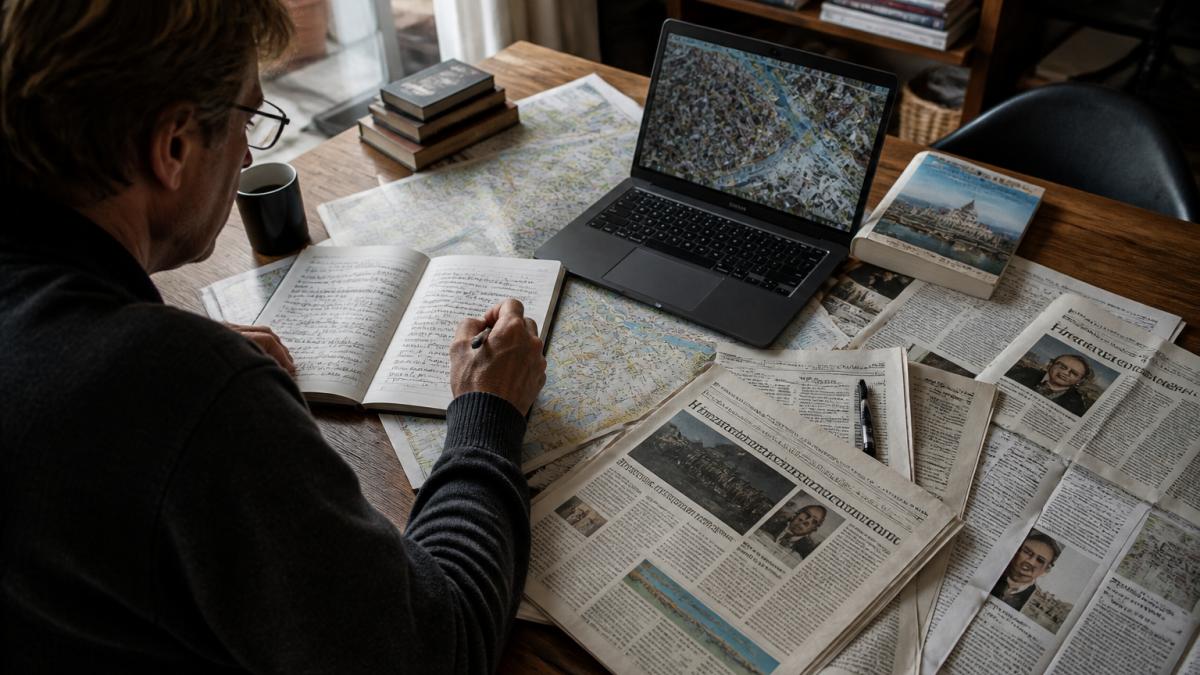
A simple workflow looks like this:
- Define the story need first. Ask what the plot requires from this place: a border crossing, a safe house, a surveillance blind spot.
- Gather open-source material. Maps, news reports, travel writing, government travel advisories.
- Find local voices. Fixers, translators, expats, or residents who can confirm or correct your assumptions.
A Step-by-Step Workflow for an International Setting
Most guides stop at “do your research” and miss the sequence. Here is a workflow you can run from anywhere.
- Write a one-page setting brief. State the country, city, time of year, and the three plot functions the location must serve, so you do not research everything and finish nothing.
- Map the jurisdiction before the geography. Identify the policing body, the court system, and the intelligence or security agency that would realistically operate there. A spy thriller lives or dies on who has authority to arrest, detain, or surveil.
- Build a source stack. For each location, collect one official source (government, court, or archive), one local news outlet, and one first-person account (memoir, interview, or long-form journalism).
- Verify across two independent sources. If a detail appears in only one place, tag it unverified and do not build a plot point on it.
- Translate and back-translate key terms. Run place names, ranks, and legal terms through a translator, then have a second speaker translate them back. Mismatches reveal idiom you would otherwise get wrong.
- Write a scene test. Draft one short scene using only your notes. Mark every detail you cannot source; those marks are your remaining research list.
Open-Source and Archive Research
Start with what is already public. National archives, court records, and declassified files often contain more texture than any travel guide.
For Australian writers, the National Archives of Australia holds records that can anchor a plot in real procedure and real paperwork.
Look for the small stuff: what a police report calls a street, how a local newspaper describes a crime, what a visa form asks.
Working With Local Fixers and Translators
Fixers and translators are cultural interpreters, not just language tools, and they catch the mistakes that mark a writer as an outsider. A good fixer can tell you how people greet each other, how far a bribe might realistically go, and which neighbourhoods a foreigner should avoid after dark. Pay them properly, credit them if they want credit, and never treat them as a shortcut to a stereotype.
Verifying Sources When You Cannot Be There
Remote research fails when a single unverified detail becomes load-bearing. A few habits prevent that:
- Triangulate proper nouns. Check street names, agency titles, and ranks against at least two independent sources, ideally one in the local language.
- Date every source. A 2019 news report may describe a police unit that has since been renamed or disbanded.
- Distinguish official from anecdotal. A government page tells you the rule; a resident tells you how it is enforced. You need both.
When you cannot visit, find a filmed walk-through, a local vlog, or a live webcam of the area. Watching real footage of a street at different times of day gives you light, traffic, and crowd patterns that no written source will.
Writing a Setting You Have Never Visited
Writing a setting you have never visited is possible, but it demands discipline. You are not faking it. You are assembling it from verified pieces.
Here is how to do it without getting caught:
- Anchor on one specific street, market, or building. Vague cityscapes read as generic.
- Use sensory detail you can verify. Heat, noise, smell, and light are safe if sourced.
- Avoid invented local customs. If you cannot confirm it, cut it.
Remote research has limits, you will never capture how a place feels at 2am. Write around that gap: focus on what your character notices, not what a travel brochure would say.
Thriller Setting Ideas That Do More Than Look Exotic
Thriller setting ideas fail when chosen for looks alone. An exotic backdrop with no bearing on the plot is just wallpaper. Strong settings do three jobs at once:
- They constrain your characters, cutting off escape routes or communication.
- They reveal something about the people who live there and the people passing through.
- They escalate the story, turning a neutral place into a threat.
A remote mountain pass is not interesting because it is beautiful. It is interesting because there is one road out and someone is watching it.
Turning a Location Into a Story Engine
Ask three questions about any location before you commit:
- What can go wrong here that cannot go wrong elsewhere?
- Who has power here, and who does not?
- What does this place force my character to do differently?
If you cannot answer all three, the setting is not carrying its weight. A city with strict surveillance changes how your spy moves; a border town with a corrupt official changes who your spy can bribe. The place should push back against the plot, not just host it.
Writing Sensory Details Without Overloading the Page
Writing sensory details is about restraint: two sharp details beat ten soft ones. Pick the senses that matter for the moment, a chase needs sound and motion, a tense wait needs heat, silence, and the body’s small tells. Sensory writing is about selection: you are describing what your point-of-view character notices under pressure, not the place itself.
A few rules that hold up:
- One detail per sense, maximum, per scene beat.
- Favour the unfamiliar over the pretty. The wrong smell tells more than the right view.
- Tie detail to emotion. A character who is afraid notices exits, not architecture.
A common mistake is stacking sensory detail in the opening of a chapter to “set the scene.” It slows the pace right when you need momentum. Spread detail through action instead of pausing the story to describe.
Cultural Accuracy, Ethics and Avoiding Stereotypes
Cultural accuracy is not decoration. It is the difference between a setting readers trust and one they dismiss. In spy and crime fiction it carries extra weight, because you are portraying institutions, police, courts, intelligence services, that real people live under.
Avoiding stereotypes starts with research, not good intentions. A country is not a single mood. It has regions, classes, politics, and contradictions. If your setting reads as one flat trait, you have not researched enough.
Getting Policing, Courts and Jurisdiction Right
This is where most spy thrillers quietly fall apart. Readers who know the system spot a jurisdiction error faster than a plot hole. Answer these questions before you write an arrest or interrogation scene:
- Who has authority here? In many countries, national police, a separate intelligence service, and local police all operate with different powers. A spy detained by the wrong agency changes the entire scene.
- What are the arrest and detention rules? How long can someone be held before a charge, and who must be notified? Getting this wrong turns a tense scene into a procedural joke.
- Does the country extradite, and to whom? Extradition treaties shape whether your character runs, negotiates, or disappears.
You do not need to be a lawyer, just know which questions to ask, and show your characters navigating the answers rather than reciting them.
Portraying Communities and Institutions Responsibly
Ethical research means a few simple commitments:
- Do not invent customs to serve your plot. If you need a ritual, find a real one or leave it out.
- Give local characters interior lives. They are not props for your protagonist, and they are not all corrupt or all heroic.
- Show institutions as systems, not caricatures. A flat “corrupt regime” reads as lazy.
A Practical Ethics Check Before You Publish
Run these questions against your manuscript:
- Could a reader from this place recognise their own street, and would they find it fair?
- Does any character exist only to represent a nationality or a religion?
- Have you used a real, named living person as a villain without strong justification?
- Would you be comfortable defending your portrayal in an interview?
If any answer makes you uneasy, that is a revision note, not a reason to abandon the setting.
Readers from the places you write about will notice. Getting it right earns their trust. Getting it wrong loses it permanently.
A common mistake is using a real, identifiable institution as a villain without understanding its actual mandate. If your plot requires a rogue agency, consider a fictional one modelled on real structures rather than naming a real body and misrepresenting it.
Turning Research Into Convincing Scenes
Research only matters when it reaches the page as story. Convert notes into action, not description.
Here is a simple method:
| Research Note | Scene Use | Effect |
|---|---|---|
| Border closes at 10pm | Character must cross before curfew | Adds a ticking clock |
| Local police patrol in pairs | Spy cannot move alone at night | Forces a risky alliance |
| Market runs only on certain days | Meeting must happen in a crowd | Hides the exchange |
| Language has a formal register | A wrong word exposes an outsider | Creates tension in dialogue |
None of these are descriptions. Each becomes a constraint or a clue, that is how research earns its place.
The same discipline applies to Arnold Van Der Vegt’s own novels, where settings are built from real travel and observation rather than postcard imagery.
If a setting detail does not create a constraint, a clue, or a mood shift, it is decoration. Cut it or make it work.
Conclusion: Research Deeply, Write Sparingly
The hardest part of writing authentic settings for spy thriller novels is knowing when to stop researching and start writing. You will always find one more detail, but at some point the notebook has to become a scene.
If you want to see how deep research turns into immersive, fast-moving storytelling, explore the novels of Arnold Van Der Vegt. His books draw on real travel, remote settings, and years of lived experience to build worlds that hold up to close reading.
Shop Now and find your next read.
Frequently Asked Questions
How do you research a setting for a spy thriller?
Start with open-source material: national archives, newspaper archives, documentary footage and published memoirs. Then layer in human sources, such as expatriates, translators or people who have lived in the region. Build a research file organised by district, not by country, because spy thriller scenes usually happen on one street, not across a whole nation. Verify every specific claim, such as a building’s height or a train timetable, against at least two sources before it goes into a draft.
How do you write a place you have never visited?
Writing a setting you have never visited works best when you narrow the frame. Instead of describing a whole city, describe one market, one stairwell, one border checkpoint. Use satellite imagery, street-level photography, local news reports and first-person accounts to build that single location in detail. Where you cannot verify something, keep the description general rather than inventing specifics. Readers forgive a lightly sketched street; they do not forgive an obviously wrong detail.
How can writers avoid clichés when depicting foreign settings?
The fastest fix is to replace the postcard image with a working detail. Instead of writing another rain-slicked alley, show what people actually do there: a night-shift baker, a broken ticket machine, a queue outside a government office. Read local journalism rather than travel brochures, and check that your characters’ names, jobs and daily routines match the region. If a detail would fit any city in the world, it is probably a cliché rather than a setting.
How can sensory details make a fictional setting more believable?
Writing sensory details works best when you limit yourself to two or three senses per scene and choose the ones that carry tension. Sound and smell usually do more work than sight, because readers expect visual description and notice when it is missing but remember when a scene smells of diesel or tastes of metal. Anchor each detail to a character action, such as a courier noticing the heat of a car bonnet, so the detail advances the scene instead of pausing it.