
Last Updated: October 29, 2026
Quick Summary
Using sensory details to create atmospheric thriller settings means building a sensory palette for each location before drafting, then writing three specific details per scene. Pick two senses and commit, and tie every detail to what the character wants or fears so the setting pushes back instead of decorating.
- Build a five-column sensory palette for each location, listing one calm and one threatened entry per sense.
- Limit scenes to three sensory details: one for each of two chosen senses, plus a third from an unused sense.
- For dread, lead with smell and touch; for discovery, lead with sight and sound.
- Slow the senses as danger rises, dropping from three details to two, then one, then cut at the chapter break.
- Plant a sensory mismatch early and pay it off late so foreshadowing feels wrong before it makes sense.
Table of Contents
- Why Sensory Details Do the Heavy Lifting in Thriller Settings
- Build a Sensory Palette Before You Write a Single Scene
- Sensory Details in Creative Writing: The Rule of Three Per Scene
- Thriller Setting Examples That Show the Method at Work
- How to Create Suspense in a Novel by Weaponising the Setting
- Writing Suspenseful Scenes: Pacing Your Sensory Beats
- Common Mistakes That Turn Atmosphere into Wallpaper
- Read a Thriller Where the Setting Breathes
- Frequently Asked Questions
Why Sensory Details Do the Heavy Lifting in Thriller Settings
A thriller setting fails when it stays scenery. Using sensory details to create atmospheric thriller settings is the difference between a location a reader skims and a place that tightens around them.
Sensory detail is the specific sight, sound, smell, texture or taste written into a scene so the reader’s body reacts before their brain does.
Atmosphere is not decoration. It is plot. A setting that creaks, stinks or burns does half your suspense work for you.
Build a Sensory Palette Before You Write a Single Scene
Most writers draft the scene first and sprinkle in atmosphere later. For guidance on writing authentic settings for spy thriller novels, start with the palette. That is backwards.
A sensory palette is a short reference sheet listing what a location looks, sounds, smells, feels and tastes like across its range, from calm to hostile. It takes an hour and saves weeks of revision.
The Five-Column Setting Audit
Run this audit on any location before you write a word of the scene:
- Sight: What is the dominant colour, and what light source creates it?
- Sound: What is the constant background noise, and what interrupts it?
- Smell: What is the first smell a newcomer notices?
Fill each column with two entries: one calm, one threatened. That contrast becomes your suspense engine.
For a deeper look at why location carries so much weight in this genre, read our piece on why setting matters in suspense fiction.
Choosing the Two Senses That Carry the Scene
You do not need all five senses in every scene. Pick two and commit.
The usual mistake is writing sight plus sound in every chapter. Try smell plus touch instead. Smell reaches memory faster than any other sense, and touch puts the reader’s skin in the room.
A quick rule: if the scene is about discovery, lead with sight and sound. If the scene is about dread, lead with smell and touch.
Sensory Details in Creative Writing: The Rule of Three Per Scene
Three sensory details per scene is the working limit. Fewer and the location feels thin. More and the prose turns purple and the pacing dies.
Here is the method:
- Choose the two senses from your palette.
- Write one detail for each of those senses.
- Add a third detail from a sense you have not used yet.
- Stop. Move to action.
That third detail is the one that surprises the reader, often a smell or texture nobody expects in that location.
Sensory details in creative writing work best when they are specific and small. “The air smelled of rain” is weak.
The rule of three also protects pacing: a thriller moves, and three details per scene keeps atmosphere dense without slowing the story.
Thriller Setting Examples That Show the Method at Work
A single location flip is useful, but the real test is whether the method survives a full scene with a main plot and a subplot running at once.
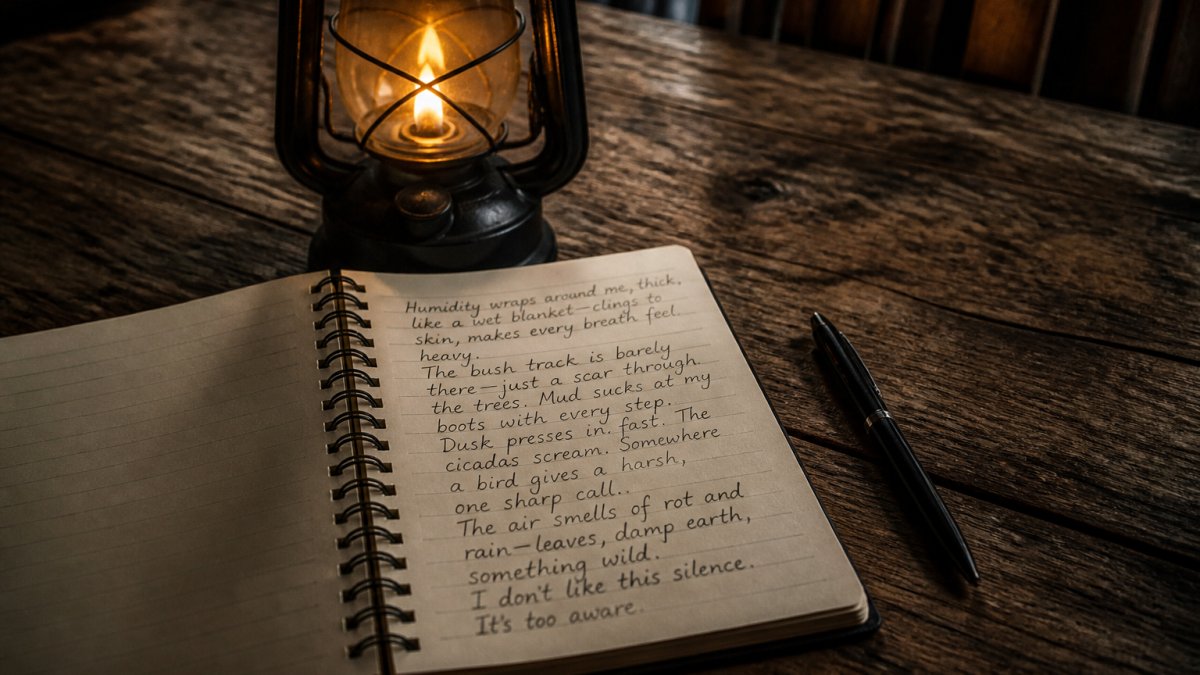
Example 1: The Bush Track at Dusk (Short Form)
Take a remote bush track at dusk. A weak draft gives you trees, a path and a sunset.
Apply the method and you get this:
- Smell: wet bark and something older underneath it.
- Touch: the track’s gravel pressing through thin boot soles.
- Sound: a single bird call, then nothing.
Three details. The reader is now standing on that track, and the silence has already started to work.
Now the threatened version, same location:
- Smell: smoke, faint and moving closer.
- Touch: the air suddenly cold on the back of the neck.
- Sight: a torch beam cutting through scrub, sweeping left to right.
Same place. The palette did the work. All you did was switch columns.
Example 2: The Coastal Caravan Park (Extended, With Subplot)
Beat 1, Arrival (calm palette, main plot seeded):
- Sight: a strip of grey beach beyond the van windows, a single kite stuck in the dunes.
- Sound: the flap of annexe canvas and a radio playing two sites over.
- Smell: salt, sunscreen and the faint chemical tang of a public barbecue.
Plant one wrong detail here: the kite has not moved in ten minutes. The reader registers it. The main plot has begun without a word of exposition.
Beat 2, Search (threatened palette, subplot surfaces):
- Touch: the wind cold on wet forearms as the mother walks the tideline.
- Sound: the same radio, now distorted by distance, and a dog barking at nothing.
- Sight: the kite gone from the dunes.
The subplot enters through the mother’s marriage: her partner is checking the wrong end of the park, and she knows why, he has been distracted for months.
Beat 3, Reveal (single-sense peak, both threads pay off):
- Touch: a child’s plastic bucket, warm from the sun, under her hand.
The bucket is the main-plot clue. The warmth is the subplot clue, someone was here moments ago, and her partner was not.
The extended example shows the pattern: pick a place, audit it, flip it from calm to hostile, and time one sensory reveal per beat so the main plot and subplot each get a turn. The setting does not just describe, it schedules.
These thriller setting examples show the pattern at two scales. The short form proves the palette works. The extended form proves it can carry a subplot without weakening pacing.
How to Create Suspense in a Novel by Weaponising the Setting
To create suspense, make the setting an active opponent. A place that only exists to be described is wallpaper. A place that blocks, hides or threatens is a character.
This is the point most craft guides skip. They teach atmosphere as mood; we teach it as opposition, and as opposition that can be scheduled across more than one plotline. That is the gap in most advice on suspense and subplots: the two are discussed separately, as if a setting only serves the main thread.
Ask three questions about every location:
- What does this place want to stop the hero from doing?
- What can it hide from them?
- What can it take from them?
Answer those, and the setting starts generating plot.
Map the Threads Against the Setting
Before drafting, build a simple thread map. List every plotline down the left side, main suspense plot, relationship subplot, side-character arc, and your key locations across the top.
A worked cell might read: Caravan park / marriage subplot, the cold wind on wet forearms as she walks the tideline alone. That single detail is both atmosphere and a subplot beat.
Schedule the Reveals
A thread map tells you what each location can do. A reveal schedule tells you when. For each subplot, decide the beat where its key sensory clue lands, and make sure it does not collide with the main plot’s biggest reveal in the same scene.
Leave a thread unresolved for no more than two scenes. Longer than that and the reader forgets why they cared; shorter and the subplot never builds.
Run the Payoff Checklist
Before you call a draft finished, audit every subplot against three questions:
- Does its sensory clue appear at least twice, once planted, once paid off?
- Does its resolution change how the reader reads the main plot’s climax?
- If you cut the subplot, would the setting lose a detail the reader would miss?
If any answer is no, the subplot is dangling. Either tie it to a setting detail or cut it. A subplot that cannot be felt through the place is a subplot the reader will skim.
Do not let every subplot resolve in the same location as the main climax. Spread the payoffs across the setting so the final act feels like the whole place closing in, not one room.
Foreshadow Danger Through the Senses
Foreshadowing works best when the reader feels it before they understand it. Sensory detail is how you plant that feeling.
Use a sensory mismatch: something in the calm palette that does not belong. A clean room that smells of bleach and something sweeter. A quiet street where the birds have stopped.
Plant the detail early, pay it off late. The best foreshadowing is invisible on first read and obvious on second, and when it is tied to a subplot, the second read reveals a whole second story running underneath the first.
Writing Suspenseful Scenes: Pacing Your Sensory Beats
Pacing is where atmosphere and momentum fight. Sensory beats are how you keep both alive.
The technique is simple: slow the senses as danger rises, then cut them.
At the start of a tense sequence, give the reader three sensory details. As the threat closes in, drop to two, then one. At the peak, give them a single physical sensation, a sound, a smell, a jolt of touch.
That reduction mimics how attention narrows under stress.
Then, at the chapter break, cut the detail entirely. End on action or a single line of dialogue.
Writing suspenseful scenes is mostly about what you remove.
Common Mistakes That Turn Atmosphere into Wallpaper
Atmosphere fails for predictable reasons. Here are the ones we see most:
- The weather report: describing sky, temperature and light with no link to the character’s goal.
- The travel brochure: beautiful description that could belong to any story.
- The five-sense checklist: jamming all five senses into every scene until the prose drags.
The fix for all five is the same. Tie every detail to what the character wants or fears in that moment. If a detail does not touch the goal, cut it.
Atmosphere fails for predictable reasons, and each mistake has the same fix. Our guide to classic mystery tropes to avoid covers the clichés behind these failures.
| Mistake | What it looks like | Fix |
|---|---|---|
| The weather report | Sky, temperature and light with no link to the goal | Tie every detail to what the character wants or fears |
| The travel brochure | Beautiful description that could belong to any story | Tie every detail to what the character wants or fears |
| The five-sense checklist | All five senses jammed into every scene until prose drags | Tie every detail to what the character wants or fears |
| The static setting | A place that never changes and never pushes back | Tie every detail to what the character wants or fears |
| The decorative smell | A scent mentioned once and never used again | Tie every detail to what the character wants or fears |
Read a Thriller Where the Setting Breathes
The test of all this craft is the reading experience. A thriller with a breathing setting does not describe a place.
Arnold Van Der Vegt’s stories draw on real travel and observation.
Arnold Van Der Vegt’s Moy Conspiracy is adult crime fiction, while the Jeremy and Melissa Mystery Adventure series is written for young teens and young adults.
If you are ready to test the method from the reader’s side, browse suspense novels with vivid, exotic settings and see which locations pull you in first.
Atmospheric settings do not happen by accident.
Frequently Asked Questions
How can sensory details build suspense in a story?
Sensory details build suspense by giving readers physical information before they get an explanation. A smell of petrol where there should be none, a floorboard that creaks half a second after a footstep, or cold air moving through a closed room all signal that something is wrong without naming it. The reader’s body reacts first and their mind races to catch up, which is exactly the state you want them in during a suspense scene. Keep each detail brief, specific, and tied to what the viewpoint character can actually perceive.
What sensory details make a setting feel threatening?
Threat usually comes from sensory information that is slightly out of place rather than from anything overtly frightening. A warm room that smells of damp earth, birdsong that stops mid-note, a surface that is sticky when it should be dry, or light that falls at the wrong angle all create unease. The key is contrast: establish what normal feels like in that setting, then remove or distort one element. Readers notice absences as much as presences, and a missing sound often unsettles more than a loud one.
How do you describe a setting without slowing down a thriller?
Attach description to action. Instead of pausing the plot to describe a room, let the character’s movement reveal it: she braced a hand against the wall and it came away gritty, or he ducked under a beam that smelled of old smoke. Aim for two or three sensory details per scene rather than a full inventory, and place them where the character would genuinely notice them. If a detail does not raise a question, increase tension, or reveal character, cut it. Pace comes from selection, not from brevity alone.
How can sound create tension in a scene?
Sound works well in suspense because it tells readers about space and distance without a map. A voice two rooms away, footsteps that stop, a fridge humming in an otherwise silent house, or rain that masks an approach all force the reader to calculate where danger is. Try removing sound entirely at the worst possible moment, then reintroducing one small noise. That single sound lands harder after silence. Keep the vocabulary concrete: name the object making the noise rather than describing the noise abstractly.
