
Last Updated: October 24, 2026
Quick Summary
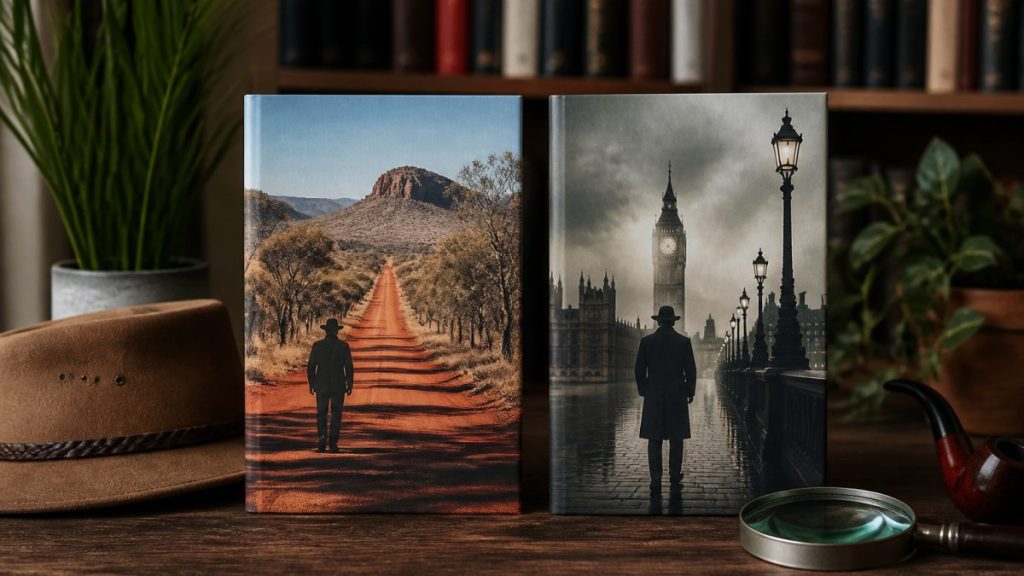
Australian crime fiction is a literature of territory, shaped by distance, heat, isolation and colonial history, where the landscape often acts as an antagonist. British crime novels are a literature of society, built on density, class structures and old institutions. Choose Australian crime fiction for atmosphere and isolation, or British crime novels for social texture and procedural detail.
- British crime fiction is a literature of society, while Australian crime fiction is a literature of territory.
- Start with Garry Disher for rural police procedure, Emma Viskic for pace, and Chris Hammer for atmosphere.
- In Australian bush crime novels, the setting functions as a suspect rather than a backdrop.
- Australian police procedurals trade grand institutional sweep for small teams and enormous geography.
- Alternate between the two traditions to sharpen your reading of each.
Table of Contents
- Australian Crime Fiction vs British Crime Novels: The Core Differences
- The Best Australian Crime Fiction to Start With
- Australian Crime Fiction Recommendations by Subgenre
- Australian Bush Crime Novels: When the Setting Is the Suspect
- Australian Police Procedural Novels and Their British Counterparts
- British Crime Fiction Traditions Worth Knowing
- How to Choose Your Next Read
- Frequently Asked Questions
Australian Crime Fiction vs British Crime Novels: The Core Differences
Australian crime fiction and British crime novels diverge most sharply in how they use landscape and institutions. Australian crime fiction is a body of work shaped by distance, heat, sparse settlement and colonial history, where the environment itself often functions as an antagonist. British crime novels are typically built on density: crowded streets, layered class structures, and institutions old enough to be corrupt in interesting ways.
At Arnold Van Der Vegt, we read both traditions closely, and the contrast is the most useful lens a reader can carry into a bookshop. Below, we break down where the two traditions part company, then recommend matched titles by subgenre so you can test both for yourself. The comparison framework we use covers setting, policing, tone and social context, and it will tell you more about your own taste than any bestseller list.
The key difference most guides miss: British crime fiction is a literature of society, while Australian crime fiction is a literature of territory. That single distinction explains almost everything else.
| Dimension | Australian Crime Fiction | British Crime Novels |
|---|---|---|
| Dominant pressure | Distance, heat, isolation | Density, class, institutions |
| Setting’s role | Often an active force | Usually a social backdrop |
| Detective model | Often rural or small-force | Often metropolitan or national |
| Tone | Dry, sun-bleached, fatalistic | Wry, procedural, socially observant |
| Historical weight | Colonial frontier and dispossession | Industrial cities and inherited class |
| Best entry point | Rural mystery or police procedural | Village mystery or urban procedural |
Landscape, Atmosphere and National Identity
Place does more narrative work in Australian crime fiction than in almost any other crime tradition. A body found in paddock country raises different questions than a body found in a London terrace: who was nearby, who could have seen, and how long until anyone passed at all. Heat, distance and silence become plot mechanics, not scenery.
British crime novels use setting differently. The village, the council estate, the coastal town and the city street map social relationships onto geography. Atmosphere comes from weather and class rather than from emptiness.
That contrast is why so many readers describe Australian crime as claustrophobic despite its wide horizons. The isolation closes in.
For a deeper look at how place generates suspense, read our piece on why setting matters in suspense fiction.
Policing, Law and Institutional Context
Institutional context separates the two traditions as much as landscape does. Australian crime fiction tends to depict state-based police services, small teams, and vast districts where backup is hours away. The investigative texture comes from resourcing stretched across distance.
British crime novels lean on a longer institutional history: metropolitan forces, national agencies, and hierarchies that generate their own internal politics. Procedure becomes a source of drama, and rank matters.
Neither tradition is more realistic than the other. They simply draw tension from different machinery. Readers who enjoy the internal politics of a British procedural often find Australian police novels refreshing for their flatter, more practical tone.
The Best Australian Crime Fiction to Start With
Start with Garry Disher if you want rural police procedure, Emma Viskic if you want a damaged protagonist and pace, and Chris Hammer if you want landscape-driven atmosphere. These three cover most of what the tradition does well, and each has a clear British counterpart you can read next for contrast.
A curated entry point helps. The reading guide to the best Australian crime fiction selected by novelist Emma Viskic is a sensible shortlist because it comes from a working crime writer rather than a marketing list.
If you are weighing two of the most prominent names in the field, our Jane Harper vs Michael Robotham comparison sets their styles side by side.
Australian Crime Fiction Recommendations by Subgenre
Matching by subgenre is the fastest way to find your footing in Australian crime fiction. The tradition is broader than outback noir, and readers who assume otherwise miss most of it.
- Rural and outback mystery: Garry Disher’s peninsula novels, Chris Hammer’s riverland books, Jane Harper’s dry-country stories
- Urban crime: Melbourne and Sydney settings with denser casts and institutional plots
- Historical crime: colonial-era stories that engage with convict settlement and frontier conflict
- Police procedural: state-force investigations with realistic resourcing and geography
- Psychological suspense: domestic and small-town novels where the threat is close to home
For a ready-made list to act on, browse the best mystery novels set in Australia.
Australian Bush Crime Novels: When the Setting Is the Suspect
In Australian bush crime novels, the setting is not a backdrop but a suspect. Heat, distance, unreliable tracks and land that does not forgive mistakes all shape what a character can do and what an investigator can prove.

This is the subgenre international readers associate most strongly with Australian crime fiction, and it is where the contrast with British crime novels is starkest. A British mystery can put the killer in the next village. A bush mystery may put the nearest neighbour two hours away.
Watch out: readers new to the subgenre often expect a fast-paced thriller and get a slow-burn study of isolation instead. Check the pacing before you commit.
If outback settings are what you are after, our list of outback mystery novels set in Queensland is the natural next step.
Australian Police Procedural Novels and Their British Counterparts
Australian police procedural novels trade the grand institutional sweep of British procedurals for small teams and enormous geography. The result is a leaner, more practical kind of investigation story.
Garry Disher’s work is the clearest example: methodical, unsentimental, and rooted in how a real investigation would be resourced. Read it beside a British procedural and the difference in institutional texture is immediate.
What most guides miss is that the Australian version often produces more tension, not less. A detective with no backup and no forensic support has fewer safety nets, and the reader feels every one of them missing.
British Crime Fiction Traditions Worth Knowing
British crime novels come with a set of traditions worth naming. The village mystery, the golden-age puzzle, the urban procedural, the psychological domestic thriller and the historical crime novel each carry their own conventions, and each has been reinvented repeatedly.
Award culture is one way into the tradition. The Gold Dagger shortlist for crime novels first published in the UK is a useful annual snapshot, and it is open to authors of any nationality, which makes it a fair comparison point with Australian work.
For readers who want modern British and Irish recommendations, the Center for Fiction’s list of modern crime books from the UK and Ireland is a solid counterpart to an Australian shortlist.
How to Choose Your Next Read
Choose Australian crime fiction when you want atmosphere, isolation and landscape-driven tension. Choose British crime novels when you want social texture, institutional politics and procedural detail. If you enjoy both, alternate them: the contrast sharpens your reading of each.
Use this checklist before you buy:
- Do you want the setting to drive the plot, or the characters’ social world?
- Do you prefer a small team with limited backup, or a layered institution?
- Are you in the mood for dry fatalism or wry social observation?
- Do you want contemporary or historical?
- Is pacing or atmosphere more important to you this month?
If you are starting a series from scratch, our guide on how to start reading Australian detective series walks through where to begin without spoiling earlier books.
The real challenge is not finding more crime novels; it is finding one that surprises you after years of reading. Arnold Van Der Vegt writes mystery and suspense shaped by real-world travel and remote settings, with plots built to keep you curious to the final page. The adult crime novel Moy Conspiracy and the Jeremy and Melissa Mystery Adventure series, written for young teens and young adults, are distinct titles for different readers. Get started with Arnold Van Der Vegt and find your next immersive read.
Frequently Asked Questions
How does Australian crime fiction differ from British crime novels?
The biggest difference is setting and what it does to the story. Australian crime fiction tends to use heat, distance and isolation as pressure on the characters, while British crime novels often work through close-knit communities, grey weather and dense procedural detail. Australian books also lean harder on dry humour and on the gap between city readers and remote places. British crime fiction carries a longer institutional tradition, so you will notice more courtroom and police-rank detail. Both traditions share the same engine: a crime, an investigator and a social world that gets exposed along the way.
What are the best Australian crime fiction books for readers of British mysteries?
If you like British police procedurals, start with Australian police procedural novels that follow a single investigator across a series, because the series format will feel familiar while the landscape will not. Readers who prefer village mysteries should look for Australian books set in small towns where everyone knows each other. If you enjoy psychological suspense, pick Australian crime fiction recommendations built around a single narrator with something to hide. The safest approach is to match the subgenre you already read rather than the country, then let the setting do the rest.
Are Australian crime novels usually police procedurals or psychological thrillers?
Both, and increasingly a blend. Australian police procedural novels remain a strong strand, especially those following a detective across multiple books, and they suit readers who want method and procedure. Alongside them sits a large body of psychological suspense and rural noir, where the investigation matters less than the pressure on a family or a town. Many contemporary Australian crime novels borrow from both: a formal investigation as the spine, with the tension coming from the community around it. If you want one or the other, check whether the description names a detective or a narrator.
What themes are common in Australian crime fiction?
Isolation and distance come up constantly, because the landscape makes help slow to arrive. Class and money run through a lot of it, particularly the divide between coastal cities and inland towns. Colonial history and the treatment of Indigenous communities appear in serious works, sometimes as the buried cause of a present-day crime. Drought, fire and water rights turn up as motive and backdrop. Family loyalty, and the cost of keeping a secret for someone you love, is probably the most universal theme. British crime novels share the family and class themes but rarely the physical isolation.
How do Australian and British crime novels use setting differently?
In Australian bush crime novels the setting is often an active obstacle: heat, distance, unreliable roads and long travel times shape what the investigator can do and when. That turns landscape into plot. British crime novels more often use setting as atmosphere and social texture, with a village, a street or a station house revealing class and history. Neither approach is better. It changes pacing. Australian settings can slow an investigation down and stretch tension across days, while British settings compress the action into a tighter social world where everyone is a suspect.
